

























Lograr que las reservas del Banco Central no caigan más. Según The Economist, esa ha sido uno de los objetivos principales de la política económica argentina tras el 35% de caída que registró el precio de la soja en el último trimestre.
En su blog sobre las Américas, el semanario de orientación liberalvinculó la caída en la actividad económica con la escasez de dólares que sufren los importadores. "Dado que Argentina importa principalmente bienes de capital, esto ha proocado a su vez una caída en la actividad económica general".
Estos son los números que emplea para justificar la afirmación: las importaciones cayeron 19,8% en un año por las restricciones en el acceso a los dólares; la producción industrial cayó 9,7% en un año (medido en agosto, datos de FIEL); la inversión doméstica bruta cayó 3,5% en el mismo período (datos de Orlando J. Ferreres); y el 33% de las empresas están reduciendo sus plantillas.
¿Cómo se resuelve esto? Según The Economist, la solución adoptada por el Gobierno es manipular una vez más las estadísticas: "El 24 de septiembre, la agencia oficial de estadísticas anunció que la economía había crecido 0,9% en el segundo trimestre, con lo que salía así de la recesión a la que había entrado en junio. Las estimaciones privadas cuentan otra historia. EconViews, otra consultora económica, informó de una contracción de 0,4% para el segundo trimestre".
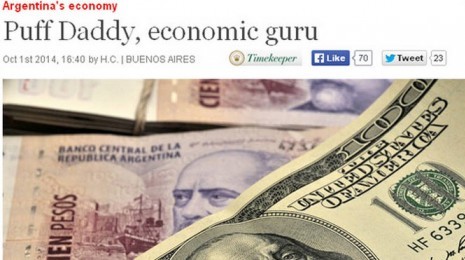
OBSERVERS of the Argentine economy could do worse than listen to Puff Daddy. Ask what the gravest cost of July’s default has been, and the answer will be along the lines of “It’s all about the Benjamins”. Had the Argentine government resolved its debt situation, it might now be able to tap international markets for hard currency. Instead it is struggling to manage its meagre reserves, which currently hover at around $28 billion.
The prospect for dollar inflows looks grim. The price of soya, Argentina’s main export and the government’s main source of dollars, has plunged by nearly 35% over the past three months to four-year lows. In hopes that this trend will reverse itself or that the government will devalue the peso, farmers are stockpiling soy rather than selling it.
Meanwhile, the government cannot tighten outflows much more than it already has. Argentines have not been able freely to buy dollars through official channels since 2011, when the government plugged them in order to stem capital flight. Since January, when the government devalued the peso by 20%, Argentines earning more than about $1,000 a month have been able to change up to one-fifth of their salary at the official rate. But those who wish to swap more of their inflation-plagued, volatile pesos for stable currencies must do so on a parallel market, referred to as the “blue”.
The blue dollar rate, which is often viewed as a proxy for economic confidence, climbed to a record high of 16 pesos to the dollar late last month. In response, the government has ordered people to simmer down. “Regarding the psychosis that there aren’t dollars and that you have to go to illegal markets to get them, it must be said: society needs to calm itself,” counselled Emmanuel Álvarez Agis, Argentina’s vice-minister for the economy, in one interview. Unsurprisingly, that has not had much effect. The blue rate has since come down a little, to 15.60 to the dollar, but it is still much weaker than the official rate of 8.5.
The government has already indirectly clamped down on imports. By making fewer dollars available to importers, the Central Bank of Argentina has fought to keep reserves close to steady. But such stinginess has led to a 19.8% fall in imports since last year. Since Argentina imports mainly inputs, this has in turn dragged down overall economic activity. According to data collected by the Foundation for Economic Research in Latin America (FIEL), industrial production was 9.7% lower in August than it had been in 2013. Orlando J. Ferreres and Associates, a consultancy, registered a drop of 3.5% in gross domestic investment over the same period. In a recent survey of 165 Argentine firms, 33% admitted to laying people off. Those in work are seeing their incomes eaten away by rising prices. According to Estudio Bein, another consultancy, salaries have risen by 28.7% in 2014, while inflation is expected to reach 40% by the end of the year.
Faced with this ugly panorama, the government appears to have returned to its old trick of data fudging. On September 24th the national statistics agency announced that the economy had grown by 0.9% in the second quarter, thereby exiting the recession it entered in June. Private estimates tell a different story. EconViews, another economics consultancy, reported a 0.4% contraction in the second quarter, writing in a report: “INDEC’s indicators have grown apart from ours again, in spite of new official methodologies.” Manipulating the numbers can work for a while but tends not to be a long-term solution. As ever, the perspicacious Mr Daddy had it right. The album from which “It’s All About the Benjamins” was taken was called “No Way Out”.